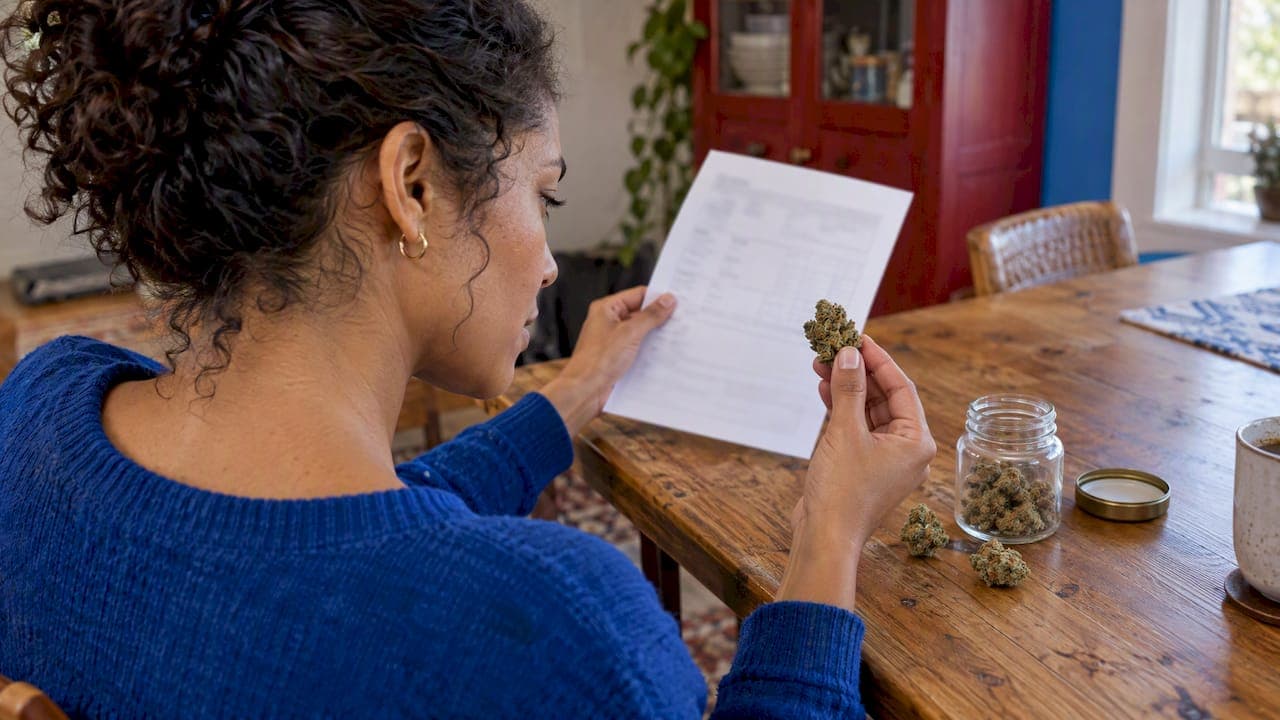
THC and terpenes do different jobs, so they are not really rivals. THC is the main intoxicating compound, and its percentage tells you how much of it is in the jar. Terpenes are the aromatic compounds that give flower its smell and flavor, and they may shape how a strain feels. If you only compare THC percentages, you miss half the picture. The better habit is to read both numbers on a lab report, then check that the flower is fresh.
TL;DR
- THC percentage measures quantity, not quality. Two flowers at 24% THC can smell, taste and feel very different.
- Terpenes drive aroma and flavor, and early research suggests some of them interact with THC. Human evidence for a full "entourage effect" is still limited.
- Labels can be off. A 2025 study found observed THC potency was significantly lower than labeled potency in flower and concentrates, so a certificate of analysis (COA) beats a sticker.
- Terpenes fade with heat, light and air, so packaging and storage decide whether a terpene number on paper reaches your nose.
- Start low and go slow, whatever the percentages say.
Table of Contents
- What THC and terpenes actually are
- Why the THC percentage alone misleads
- What terpenes do, and what they do not
- The entourage effect, in plain terms
- Sleep and other "what is it good for" questions
- Does a strain name tell you what you will get?
- How to compare flower using both numbers
- Freshness decides whether terpenes survive
- How cultivation affects the terpene profile
- Our perspective
- Where to start with Cali Farms flower
- A practical way to dose, whatever the percentages say
- FAQ
- Sources
What THC and terpenes actually are
THC (tetrahydrocannabinol) is a cannabinoid. It is the primary psychoactive component of cannabis, and it is what most buyers mean when they ask how strong a flower is.
Terpenes are a separate class of molecules. They are aromatic compounds found abundantly in plants, cannabis included. The citrus snap of a lemon peel, the pine of a forest and the lavender in a garden all come from terpenes. In cannabis, they are why one jar smells like diesel and the next like candied cherries.
So the comparison in the keyword is a little like asking whether alcohol content or flavor matters more in a drink. One tells you how much, the other tells you what you are getting. Most people want both.

Why the THC percentage alone misleads
A THC percentage is a weight fraction. The Washington State Liquor and Cannabis Board explains that a higher percentage does not mean a better experience: it indicates how much THC is present, not how good the product is or what it will feel like. Twenty percent THC means roughly 200 mg of THC per gram of flower.
Three problems come with chasing the biggest number.
More THC is not always more enjoyable
The same agency notes that high THC can overstimulate the system and raise the risk of unpleasant effects such as paranoia or an increased heart rate. It also cites a 2020 study in which people showed no marked differences in subjective, cognitive or physiological effects between 16-24% THC flower and 70-90% THC concentrates. The relationship between percentage and experience is far looser than the marketing suggests.
Labels are not always accurate
A 2025 study in Scientific Reports compared labeled and measured potency. It found that observed THC was significantly lower than labeled in both flower and concentrates, and that flower missed a plus or minus 15% accuracy threshold more often than concentrates did. Earlier work on Washington State data found that cannabinoid content varies systematically across testing facilities, which is a polite way of saying that the same number from two labs may not mean the same thing.
"Total THC" and "Delta-9 THC" are not the same figure
In raw flower, much of the potential THC sits in its acid form, THCA, and a report may show several related numbers. If you have seen two different THC values for one batch, our explainer on why delta-9 and total THC can differ walks through it.
What terpenes do, and what they do not
Terpenes are the easiest part of cannabis to notice and the hardest to prove things about. Here is what the research supports.
They shape aroma and flavor. This part is not in dispute. Aroma is the reason terpenes are described as the primary constituents of essential oils in the plant.
They are pharmacologically active. A 2025 review in Biochemical Pharmacology reports that terpenes can be absorbed through inhalation, the skin and the gut, and that individual terpenes activate cannabinoid receptors at roughly 10-60% of the level THC does. That is weaker than THC, but not zero.
They may change how THC acts. A laboratory study found that selected terpenes synergize with THC to increase CB1 receptor activation. Cell-based findings like this are a reason to take terpenes seriously. They are not proof of a specific effect in a person smoking a specific strain.
They are not a cure-all. Clinical reviews suggest terpenes may help with symptoms such as pain or anxiety, but the same reviews say that evidence of a consistent entourage effect in humans remains limited, and different terpenes behave differently. If you are using cannabis for a medical reason, including sleep problems or an autoimmune condition, talk to your own physician. Research on THC and autoimmune disease is at an early stage, and a narrative review of medical cannabis found no conclusive clinical evidence that THC treats autoimmune disease itself.
The entourage effect, in plain terms
The entourage effect is the idea that cannabinoids, terpenes and flavonoids work together, so the whole plant does something different from isolated THC. A widely cited paper, Taming THC, laid out the case for phytocannabinoid-terpenoid synergy.
Researchers writing in The Conversation describe it as a valid hypothesis that is not yet a fully mapped science. It helps explain why two products with the same THC and CBD content can feel different. It does not yet tell you that "limonene means energy" or "myrcene means couch lock".
A sensible reading: terpenes are a plausible reason for differences you notice, and a useful way to find flower you like, but a guarantee of effect is beyond what the science can promise.
Sleep and other "what is it good for" questions
Readers often ask which terpenes are good for sleep. The honest answer is mixed. In observational registries, sleep improvement was reported by 49% to 89% of patients using various cannabis products, yet individual responses vary a lot. High THC doses can disturb sleep, while some terpenes and lower THC doses may shorten the time it takes to fall asleep. That points back to dose, not just the percentage on the label.
If sleep is a persistent problem, a doctor or sleep specialist is the right person to see. Cannabis should not stand in for that conversation.
Does a strain name tell you what you will get?
Not reliably. A study of Nevada medical cannabis samples concluded that common chemovar names misrepresent chemical and genetic diversity. The Indica and Sativa split is a weak guide too, which we cover in what the Indica vs. Sativa labels really tell you.
The lab report is a better guide. It shows the real cannabinoid and terpene profile of that specific batch, rather than the reputation of a name.
How to compare flower using both numbers
Here is a simple routine you can use at the shelf or on a product page.
- Find the batch COA. It should come from a third-party lab and match the batch number on your package. If you are new to these documents, start with how to read a hemp flower COA or the more detailed certificate of analysis walkthrough.
- Check the cannabinoids. Note the THC (and THCA) figures, and whether the report states total THC. For how labs arrive at those numbers, see cannabinoid testing methods explained.
- Read the terpene panel. Look at the top three or four terpenes, not just the total. Our guide to reading a terpene test report explains the columns.
- Trust your nose. Aroma should match the panel. A flat or hay-like smell on a flower with a rich terpene report is a warning sign.
- Choose your dose first. Pick the amount you are comfortable with, then use the percentages to scale it.
The table below summarizes how the two numbers compare.
| THC percentage | Terpene profile | |
|---|---|---|
| What it tells you | How much THC is in the flower | Which aromatic compounds are present and in what proportion |
| Best for judging | Dose and intensity | Flavor, aroma, and possibly how effects feel |
| Known weakness | Labels can overstate potency | Evidence for specific effects is still limited |
| How to verify | Batch COA from an independent lab | Batch COA with a full terpene panel |
| Changes with age | Slowly | Quickly, with heat, light and air |
Freshness decides whether terpenes survive
Terpenes are volatile. A study of terpene stability in cannabis flower found that heat, light and oxidation change them into other compounds, with p-cymene a major product of terpene aging. That means a terpene percentage measured at the lab on harvest day is not guaranteed to reach you intact.
In practice:
- A strong, layered smell when you open the jar is a good sign of freshness.
- Store flower in an airtight container, away from heat and sunlight.
- Be wary of flower that has sat in clear containers under bright lights.
This is also why packaging is not a cosmetic issue. It is part of keeping the profile you paid for.
How cultivation affects the terpene profile
Growing method matters too. A 2023 study found that inoculating cannabis with beneficial soil bacteria (PGPR) improved biomass and secondary metabolite accumulation, the group of compounds that includes terpenes. This was one experimental study, not a verdict on every farm, but it fits what many growers say about living soil: a biologically active root zone supports a more complete profile.
If you are comparing suppliers, ask whether they control their own cultivation and whether they can show batch-level lab results. For a related look at the grow environment, see indoor vs. outdoor weed and what changes in the jar.
Our perspective
We grow in living soil and we do not use plant growth regulators (PGRs). We made that choice because we want each strain to keep its authentic terpene profile, and because we control the process from seed to sale, we can stand behind what we describe.
Our view on THC vs. terpenes is simple. THC percentage is a useful dose number, but it is a poor quality number. We would rather a customer judge a jar on its batch COA, its aroma and how it fits their tolerance than on the largest figure on the label. That is why we publish lab-verified results for our batches and pack flower in packaging engineered to protect freshness.
We also think the industry should be honest about what is unknown. The entourage effect is an interesting hypothesis, not a promise. We would rather tell you that and give you the tools to read a lab report than sell you a story.
— Cali Farms
Where to start with Cali Farms flower
If you want to put this into practice, browse the Cali Farms Flower Collection and open the batch lab results alongside each strain. Our strain profiles show the terpene-forward character of each cultivar, and you can compare batches in our guide to THCA flower ranked by batch quality. Retailers and distributors can ask us about wholesale through the same site.
If you want a terpene-led place to begin, look at a citrus-forward profile such as Lemon Cherry Gelato or the classic Durban Poison, and compare their panels side by side.

A practical way to dose, whatever the percentages say
Because THC's unwanted effects, including cognitive impairment, anxiety and paranoia, are dose-dependent, the aim is the smallest amount that gives you what you want. The Washington State Liquor and Cannabis Board advises you to start low and go slow, and to wait 5-10 minutes after one or two puffs before taking more when inhaling or vaping.
A higher-THC flower means a smaller dose, not a bigger one. A terpene-rich flower may feel more pronounced at a lower THC level, so give it a small first trial. Do not drive or operate machinery after use, and check the laws in your state, since cannabis rules differ by state and federal law still treats cannabis differently from hemp.
FAQ
Do terpenes matter more than THC?
They matter for different reasons. THC is the main driver of intoxication and sets how strong the flower is. Terpenes shape aroma and flavor, and they may modify how THC feels, although human evidence is limited. For most buyers, the best choice weighs both.
Does THC percentage matter?
Yes, as a guide to dose. It matters less as a measure of quality. Labeled potency can also differ from measured potency, so a batch COA from an independent lab gives you a more reliable figure than the label alone.
What is a good percentage of terpenes?
There is no official standard we can point to, and terpene totals vary widely between cultivars and between labs. Look at the profile as well as the total: which terpenes are present, whether the smell matches the report, and how fresh the flower is.
Are terpenes safe to consume?
Terpenes are generally recognized as safe by the FDA as food additives, according to the 2025 review of cannabis terpenes. That status does not cover every route of use, including inhalation. If you have asthma or another respiratory condition, ask your doctor before smoking or vaping anything.
Sources
- Accuracy of labeled THC potency across flower and concentrate cannabis products
- What is the "Right" Amount of Cannabis for Me? Washington State Liquor and Cannabis Board
- Selective activation of cannabinoid receptors by cannabis terpenes
- Selected cannabis terpenes synergize with THC to produce increased CB1 receptor activation
- Taming THC: potential cannabis synergy and phytocannabinoid-terpenoid entourage effects
- The entourage effect: what we don't know about how cannabis works
- Clinical Benefits and Safety of Medical Cannabis Products: A Narrative Review on Natural Extracts
- Cannabis Chemovar Nomenclature Misrepresents Chemical and Genetic Diversity
- The Cannabinoid Content of Legal Cannabis in Washington State Varies Systematically Across Testing Facilities
- Comprehensive analysis of chemical and enantiomeric stability of terpenes in Cannabis sativa L. flowers
- Plant Growth-Promoting Rhizobacteria with Microbial Growth Broth Improve Biomass and Secondary Metabolite Accumulation of Cannabis sativa L.