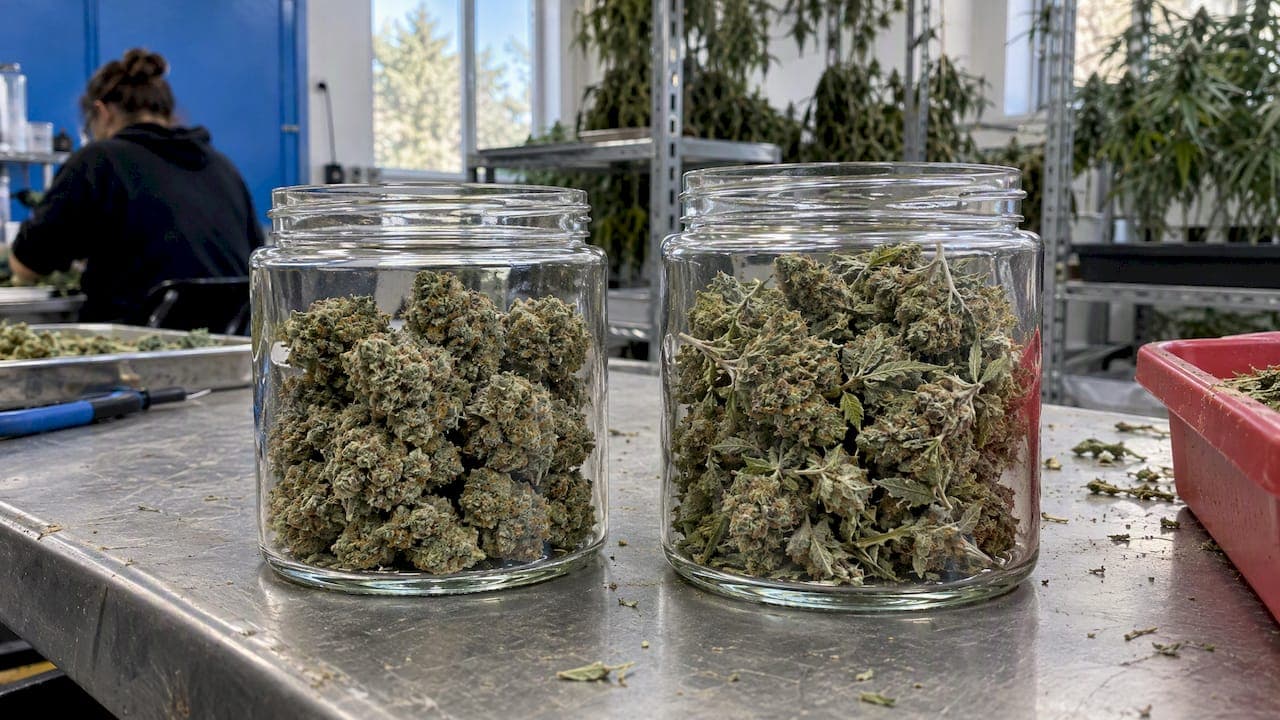
Indoor weed is grown under artificial light in a controlled room. It usually wins on consistency and bag appeal. Outdoor weed is grown under the sun. It often wins on terpene complexity, cost and environmental footprint. Neither method guarantees quality. The grower's skill, the soil, the drying and curing, and the lab results matter more than the label "indoor" or "outdoor".
This guide covers what really differs between the two, where greenhouse flower fits, how to judge a jar yourself, and how THCA flower and "regular" THC flower relate to the same question.
TL;DR
- Indoor means precise control, year-round supply and tight, photogenic buds. Outdoor means sunlight, seasonal harvests, lower costs and often a broader terpene range.
- A 2023 study of genetically matched plants found more sesquiterpenes in sun-grown samples. So outdoor can smell and taste more complex.
- Top-shelf flower exists in both camps. Ask for the batch COA, not just the THC percentage.
- THCA flower and THC flower are the same plant chemistry. The difference is mostly legal, and heat turns THCA into THC.
- We grow indoors in living soil without plant growth regulators, and we publish lab results. See our flower collection.
Table of Contents
- How indoor and outdoor cultivation differ
- Does indoor weed have higher THC?
- Terpenes: where outdoor often shines
- Looks, trim and structure
- Greenhouse: the middle ground
- Price and sustainability
- What matters more than indoor or outdoor
- Our perspective: control the process, keep the terpenes
- THCA flower vs THC flower: the part everyone mixes up
- Which should you buy?
- Try indoor flower grown in living soil
- FAQ
- Sources
How indoor and outdoor cultivation differ
The two methods are different production models. According to Herb, indoor growing gives precise, year-round control over light, temperature and humidity. That maximizes consistency and bag appeal, but it costs more in energy and equipment. Outdoor growing uses natural sunlight and is generally cheaper. It is also seasonal, and plants are more exposed to weather, pests and environmental stress.
Here is the practical side-by-side:
| Indoor | Outdoor | Greenhouse | |
|---|---|---|---|
| Light | Artificial, fully controlled | Sun | Sun, with some protection or light deprivation |
| Harvests | Year-round | Usually once a year | Often more than one |
| Looks | Dense, uniform, heavily trimmed | Varies more by plant | Between the two |
| Terpenes | Can be excellent, depends on grower | Often broader range | Often a hybrid result |
| Cost to grow | Highest | Lowest | In between |
| Weather risk | Minimal | High | Reduced |
Indoor cultivation is attractive because the grower can repeat a result. Project CBD notes that indoor production is not seasonal and is not limited by outside conditions. That is why retailers lean on indoor flower for steady supply and uniform looks.
Outdoor flower is not simply the cheaper version. Sun-grown cannabis is increasingly valued for its natural terpene profiles and lower environmental footprint, according to the same source. Its quality depends heavily on climate, genetics and harvest timing. The grower's skill and commitment to the plant's environment matter more than the setting alone.
Does indoor weed have higher THC?
It is a common belief, and tightly controlled indoor rooms are often built to push potency. But a THC number on a label tells you less than you would hope.
Three reasons to treat it with caution:
- Light recipe matters. A study on light quality in enclosed cultivation found that poorly designed light spectra can cut total cannabinoid production by 20 to 40%. Indoor does not automatically mean potent. It means the grower has the controls to get it right or wrong.
- Standard COAs miss things. The 2023 Molecules paper points out that routine testing often skips specific sesquiterpenes and oxidized cannabinoid degradation products such as CBNA. The study notes that indoor samples tended to contain higher levels of oxidized and degraded cannabinoids.
- Percentage is not the experience. Terpenes shape aroma, flavor and how a strain feels. Two jars with the same THC number can behave very differently.
If you are asking whether outdoor weed gets you higher, the honest answer is that it depends on the batch. Compare terpene content and total cannabinoids on the lab report. Do not rely on the growing method.
Terpenes: where outdoor often shines
The strongest published evidence for a real difference is in terpenes. In the 2023 study in Molecules, researchers compared commercial cannabis from natural and artificial cultivation. They found that sun-grown samples showed higher levels of sesquiterpenes such as β-caryophyllene, α-humulene, α-bergamotene, α-guaiene and germacrene B, compared with genetically identical plants grown indoors under artificial light.

What that means in the jar: outdoor flower can have a deeper, earthier, more layered nose. Indoor flower can still be loud and flavorful. But it takes careful handling to keep delicate aromatics intact, especially during drying and curing.
That is the heart of our approach at Cali Farms. We grow indoors in living soil, without plant growth regulators, to preserve each strain's authentic terpene profile. For a closer look at the aromatics themselves, see our guide to hemp flower terpenes.
Looks, trim and structure
If you buy by eye, indoor usually has the edge. Indoor buds tend to be denser and more uniform, with consistent color and a tidy trim. Outdoor buds can be airier, vary more in size, and carry more environmental fingerprints.
That is cosmetic, not a quality verdict. A beautiful bud can be flat on aroma, and a rougher-looking one can be superb. Use the eye as a first filter, then use your nose and the COA.
How to tell which one you are holding
Beyond appearance, there is no reliable home test. Researchers can do it: a study of cultivation settings found that carbon isotope ratios of plant wax compounds can tell indoor from outdoor flower with about 90% accuracy. You cannot do that on your kitchen table, so your practical tools are:
- Ask the seller. A reputable brand states how the flower was grown.
- Smell the jar. Muted aroma suggests poor curing or age, whichever method was used.
- Check the structure. Overly dense, glossy buds with little scent can point to rushed growth or a rushed dry.
- Read the COA. Terpene totals and the named compounds tell you more than a marketing line.
Greenhouse: the middle ground
A lot of readers also ask how indoor compares with greenhouse weed. A greenhouse uses natural sunlight but adds structural protection. Herb describes it as a hybrid model that offers some shelter from the elements while still using the sun. Some greenhouses add light deprivation, which lets growers trigger flowering early and harvest more than once a year.
Expect greenhouse flower to sit between the two on price, looks and terpene complexity. The range is wide, because one greenhouse may be nearly an outdoor grow and another may be nearly an indoor room with a glass roof. Treat it as a category to evaluate batch by batch.
Price and sustainability
Outdoor is cheaper to produce, so it often sells for less. Indoor carries energy and equipment costs, and those flow into price. If the flower is grown carefully, handled well and tested, indoor can still justify its premium. If it is grown fast and cured badly, it cannot.
Sustainability-minded buyers lean outdoor or greenhouse because of the smaller footprint. That is a fair consideration. It is also a reason to ask any indoor grower what they do about energy, water and waste.
What matters more than indoor or outdoor
If you remember one thing from this page, make it this: growing method is a starting point. These factors predict quality better:
- Genetics and phenotype. A great cultivar in a mediocre grow beats a mediocre cultivar in a great one.
- Soil and inputs. Living soil supports a different plant than a sterile, input-heavy medium.
- No plant growth regulators. We grow without PGRs, so our flower is not forced into artificially dense buds.
- Harvest, dry and cure. This is where terpenes are saved or lost.
- Batch size. Small runs are easier to watch closely. Our small-batch hemp flower guide explains why this helps.
- Testing. The New Jersey Cannabis Regulatory Commission's testing guidance shows the kind of screening regulators expect, covering pesticides, heavy metals, mold and foreign material. Rules vary by state, but a batch-specific lab report is the baseline for trust.
Our perspective: control the process, keep the terpenes
We do not think indoor beats outdoor, or the reverse. We think flower is only as good as the care behind it. For us, that means controlling the process from seed to sale, so no step is a black box.

Our flower is grown indoors in living soil, without PGRs. We chose indoor because it lets us deliver the same quality jar after jar, and living soil because it helps us keep each strain's real terpene profile intact. Then we verify the result. Every batch is lab-tested, with terpene profiles and COAs available, and the flower goes into engineered packaging designed to preserve freshness.
We also think shoppers deserve better than a single THC number. When you read a COA, look at the terpene breakdown, the total cannabinoids and the safety panels. Our guides on reading a hemp COA and how to read a hemp certificate of analysis walk through it line by line. If you want the indoor and outdoor trade-offs from our side, our article on indoor vs outdoor hemp flower goes deeper.
— Cali Farms
THCA flower vs THC flower: the part everyone mixes up
Many readers land on this topic while sorting out hemp and cannabis labels. The short version: the difference between THCA flower and THC flower is largely legal rather than chemical. Raw flower is mostly THCA and has little delta-9 THC.
Is THCA psychoactive?
Not in its raw form. THCA is a non-psychoactive precursor that converts to THC when heated, a process called decarboxylation. Smoking, vaping or baking the flower triggers it. After that, the effects are those of THC.
Hemp vs cannabis flower
The legal line comes from the 2018 Farm Bill. It defines hemp as cannabis containing no more than 0.3% delta-9 THC on a dry-weight basis. Flower that meets that standard is hemp. Flower above it is marijuana, which remains a controlled substance under federal law and is legal only under individual state programs. The plants are the same species, and the labels reflect the paperwork.
This area is moving. Congress has passed changes to the federal hemp definition that are scheduled to take effect in November 2026, and they could affect THCA flower. Check the current federal and state rules, and your state's cannabis authority, before you buy or stock anything. If you are a retailer, confirm compliance with your own attorney.
THCA flower vs delta-9 and why the numbers differ
A COA often lists delta-9 THC and THCA separately. After heating, THCA contributes to total THC. That is why a flower can show a low delta-9 number and still deliver strong effects when smoked. Our explainer on delta-9 THC and total THC shows how to read the two numbers together. For the methods behind them, see cannabinoid testing methods explained.
THCA vs CBD flower
CBD flower is bred for cannabidiol and is not the same product as THCA flower. THCA flower is high in THCA and becomes intoxicating when heated. CBD flower is chosen for a different profile. Check the COA to see which cannabinoid leads.
Which should you buy?
Pick by what you value:
- You want consistency and standout looks: choose indoor from a grower who publishes batch COAs.
- You want a wide, earthy terpene range at a friendlier price: look at sun-grown or greenhouse flower, and check harvest date and curing.
- You are a retailer or distributor: indoor offers steady supply and uniform appearance, while sun-grown adds a sustainability story. Our retailer buying guide for smoke shops covers what to ask suppliers.
- You are choosing a first jar: use our premium hemp flower guide to compare appearance, aroma and testing.
Try indoor flower grown in living soil
If you want indoor flower with its terpenes intact, start with our Cali Farms flower collection. You can also look at individual strains such as Wedding Cake or Gorilla Glue (Glue State). Each is grown without PGRs and lab-verified. Retailers and distributors can ask about wholesale. For a wider look at what sets exotic cultivars apart, read about exotic hemp flower strains.

FAQ
Is outdoor weed more potent than indoor weed?
Not necessarily. Indoor rooms are often tuned for high THC, but potency depends on genetics, light design and handling. One study found that poor spectral design can reduce cannabinoid production by 20 to 40%. Compare the batch COA instead of the growing label.
Does outdoor weed get you higher?
It can feel different rather than stronger. Sun-grown flower often carries more sesquiterpenes, which shape aroma and may influence the experience. How high you feel depends on total THC, terpenes, your tolerance and how you consume it.
Is it better to smoke indoor or outdoor weed?
It is a matter of preference. Indoor is typically more consistent and visually polished. Outdoor is often more aromatic and more affordable. Whichever you choose, buy flower that has clean lab results, a fresh aroma and a proper cure.
How can you tell if weed is indoor or outdoor?
Look for dense, uniform, tightly trimmed buds as a hint of indoor, and more varied structure for outdoor. This is only a hint. Labs can distinguish them using carbon isotope ratios, but at home the best answer is to ask the seller and check the COA.
Sources
- Comparison of the Cannabinoid and Terpene Profiles in Commercial Cannabis from Natural and Artificial Cultivation (PMC)
- Indoor vs. Outdoor vs. Greenhouse Weed (Herb)
- Sungrown vs. Indoor Cannabis Cultivation (Project CBD)
- Light Quality Impacts Vertical Growth Rate, Phytochemical Yield and Cannabinoid Production Efficiency (PMC)
- The influences of cultivation setting on inflorescence lipid distributions and carbon isotope ratios (PubMed)
- New Jersey CRC testing guidance, February 2025
- THCA Flower VS THC Flower
- Understanding THCa: Origins, Uses, and Legal Status
- The 2018 Farm Bill's Hemp Definition (Congressional Research Service)