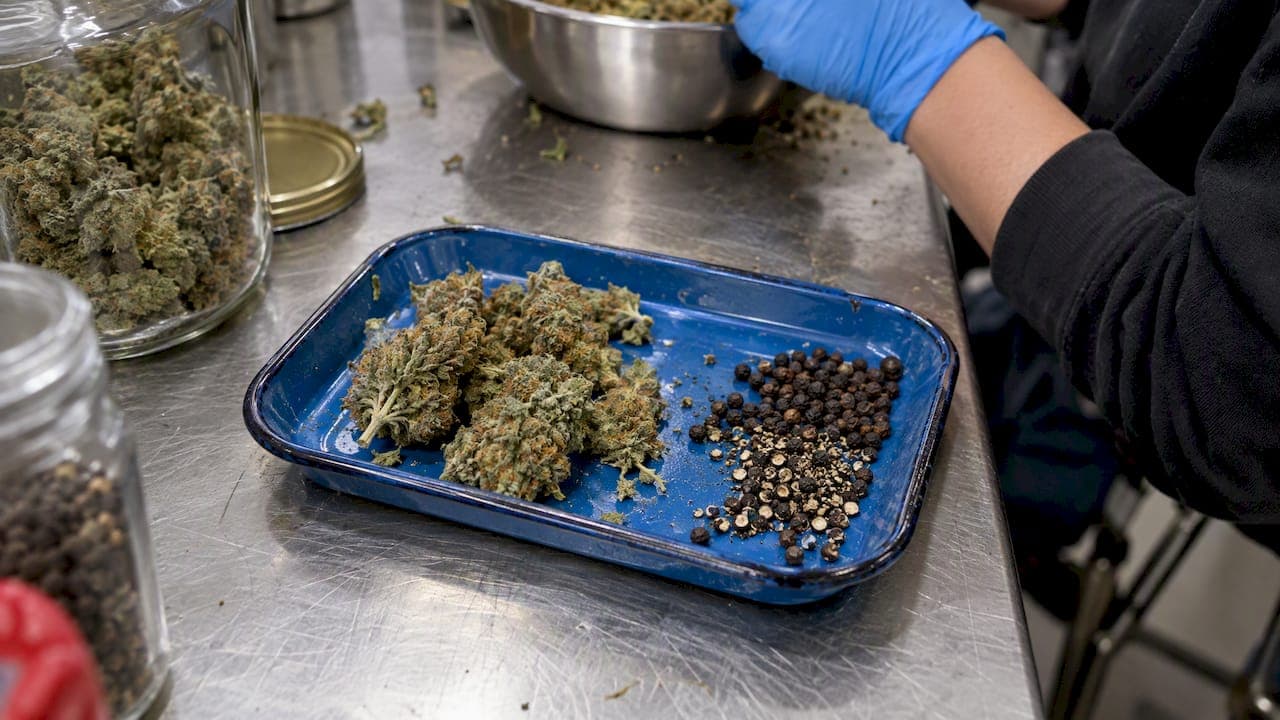
Caryophyllene is the peppery terpene in black pepper, cloves and many cannabis cultivars. It is studied for inflammation, pain, mood and brain health because it can activate the CB2 receptor without causing a high. The honest summary is that the lab and animal data look interesting, human evidence is thin, and no terpene on a label guarantees an effect. Below we cover what caryophyllene is, what has been studied, what it feels like, how it compares with myrcene, and how to find it in flower.
TL;DR
- Caryophyllene (usually beta-caryophyllene) is a spicy, woody terpene found in cannabis, black pepper and cloves.
- It is a putative CB2 receptor agonist, and it is not known to cause intoxication.
- Most evidence for pain, inflammation and neuroprotection comes from animal and cell studies, not human trials.
- Myrcene is the earthy, musky terpene often linked to relaxing effects, but that link also rests mostly on animal work.
- To find caryophyllene-dominant flower, read the batch terpene report, not the strain name.
Table of Contents
- What caryophyllene is
- Why it gets called a dietary cannabinoid
- The benefits researchers have studied
- How strong is the evidence, really?
- What does caryophyllene feel like?
- Caryophyllene vs. myrcene
- Strains high in caryophyllene (and myrcene)
- How to check caryophyllene in a batch
- Our perspective
- Find caryophyllene-forward flower with us
- What to take away
- FAQ
- Sources
What caryophyllene is
Caryophyllene is a bicyclic sesquiterpene with a woody, spicy aroma. Beta-caryophyllene (BCP) is the most abundant and most studied form. It differs from relatives such as isocaryophyllene and alpha-humulene in its molecular structure, according to a 2021 review of cannabis-derived terpenes for pain.
You have almost certainly smelled it. BCP occurs in Cannabis sativa, cloves and black pepper, which is why a freshly cracked peppercorn and a jar of certain flower share a bite. When someone describes a strain as "peppery" or "spicy," caryophyllene is often part of the reason, though other terpenes contribute too.
If you want the broader picture of how terpenes combine into an aroma, our guide to reading a terpene profile walks through it.
Why it gets called a dietary cannabinoid
Most terpenes act on smell receptors and perhaps a few other targets. Caryophyllene is unusual because researchers describe it as a putative full agonist of the CB2 receptor. CB2 receptors are found largely in immune tissue and are involved in inflammation signaling.
It matters that this is CB2 and not CB1. A review in Alternative and Complementary Therapies notes that BCP does not bind the CB1 receptor in the brain, so it is not expected to produce a psychoactive effect. That is the main reason it draws research interest: a compound that touches the endocannabinoid system without the high that THC brings.
The benefits researchers have studied
Here is the list you will see on most pages, with the level of evidence next to each one.
Inflammation
BCP has been examined for anti-inflammatory activity. The same Alternative and Complementary Therapies review reports that in experimental models it lowered inflammatory signals such as TNF-alpha and interleukin-6. Italian researchers also summarized preclinical work in animal and cell models of inflammatory disease, including colitis.
This is the best-supported category, but "best supported" still means models, not patients.
Pain
A 2021 review lists antiallodynic and antinociceptive effects for BCP in preclinical models, meaning reduced pain responses in animals. That is a long way from "treats chronic pain in people." Pages that promise pain relief from a caryophyllene-rich jar are running ahead of the data.
Neuroprotection, mood and anxiety
Animal and cell studies have looked at neurodegenerative disease, depression and anxiety. A 2021 review of BCP as a dietary CB2 agonist and the Italian summary both frame these as promising signals. The Alternative and Complementary Therapies authors say early animal work suggests possible benefit but that human trials of efficacy and safety are still needed.
Everything else
You will also see claims about skin, digestion, metabolism, addiction and even mosquito repellency. Some are studied, most are early. We treat them as interesting questions rather than benefits you can count on.
How strong is the evidence, really?
Review authors say it plainly: evidence for BCP's medical benefits in humans remains limited, with most research confined to animal or in vitro studies. A mouse that responds to a purified compound in a lab tells you where to look, not what will happen when you smoke a flower with 0.4% of that compound in it.
Dose is the second problem. Studies use isolated BCP in measured amounts. A cannabis flower contains a mix of dozens of terpenes and cannabinoids in amounts that vary from batch to batch.
The third problem is the entourage effect. Retail marketing leans on it heavily, but a 2019 review from Australian researchers concluded that compelling evidence for cannabinoid and terpenoid synergy does not yet exist, despite what websites and dispensaries say. So if a label tells you caryophyllene will amplify THC in a predictable way, be skeptical.

None of this makes caryophyllene dull. It makes it a good reason to pay attention to aroma and testing, and a poor reason to treat flower as medicine.
What does caryophyllene feel like?
This is the question people actually type, and the honest answer is: subtle. Nobody has published a clean human study of inhaled caryophyllene from cannabis flower alone, so there is no checked, quantified account of its effects in people.
What we can say:
- It is not intoxicating on its own. The CB1 point above is why researchers do not expect a high from it.
- Aroma is the one effect you can verify yourself. Peppery, woody, clove-like notes on the nose and a warm, spicy finish on the palate are the signature.
- Effects people attribute to it are anecdotal. Many describe a calm, grounded feel, but that experience is bound up with THC level, dose, tolerance, setting and expectation.
If you take medication, are pregnant, or are managing a medical condition such as chronic pain or anxiety, talk to your physician or pharmacist before using cannabis for it. Cannabis can interact with other drugs, and a terpene is not a treatment.
Caryophyllene vs. myrcene
Myrcene is the other terpene readers ask about most, so here is the short version.
What myrcene is
Myrcene is among the most prevalent cannabis terpenes, recognized for a musky, earthy, fruity fragrance. Think ripe mango, damp soil, hops. It is a monoterpene, a smaller molecule than caryophyllene.
What myrcene does
Laboratory-animal studies report sedative, analgesic and muscle-relaxant effects for myrcene. A 2011 review adds that together with THC it may contribute to the "couch-lock" phenomenon. A 2025 US study found that purified myrcene produced antinociceptive effects in a mouse model of chronic neuropathic pain, while noting that whether terpene effects in mice carry over to humans remains to be investigated.
So the pattern is the same as caryophyllene: suggestive animal data, no firm human conclusions.
Side by side
| Caryophyllene | Myrcene | |
|---|---|---|
| Terpene type | Sesquiterpene | Monoterpene |
| Aroma | Peppery, woody, spicy | Musky, earthy, fruity |
| Also found in | Black pepper, cloves | Hops, mango (commonly cited) |
| Receptor interest | Putative CB2 agonist | Sedative and analgesic signals in animals |
| Human evidence | Limited | Limited |
The "also found in" row for myrcene is common knowledge in the terpene world rather than a claim we are tying to a study here, so treat it as a general aroma pointer.
Strains high in caryophyllene (and myrcene)
Strain names are loose labels. The same name from two growers can test very differently, and terpene analysis still lacks standardization, with results varying across labs. That said, research gives some starting points.
A US study of terpenoid chemotypes reported that cultivars such as Girl Scout Cookies, Sherbert and Gorilla Glue #4 were dominated by beta-caryophyllene. If you search for beta caryophyllene strains, caryophyllene-dominant strains or high caryophyllene strains, those cookie and glue families are the usual answer.

On the myrcene side, the 2025 study's high-myrcene terpene blends were labeled Fruit #18 and Sweet #50, which are research blends rather than retail strains. In practice, the best way to find high-myrcene flower is the same as for caryophyllene: read the report for that batch.
Where our menu fits
We grow and sell Girl Scout Cookies and a Gorilla Glue line called Glue State. Both belong to families the research associates with caryophyllene dominance. We still say the same thing to every customer: a family tendency is not a promise. Open the terpene report for the batch in front of you and look at the actual percentages.
How to check caryophyllene in a batch
- Find the certificate of analysis. Reputable sellers publish one for each batch. Our walkthrough on how to read a hemp certificate of analysis covers the layout.
- Go to the terpene panel. Not every COA includes one. If it does, find beta-caryophyllene in the list. Our guide to reading a terpene test report explains the columns and units.
- Rank the top three to five terpenes. A caryophyllene-dominant batch has it at or near the top. Compare it to myrcene, limonene and humulene to see the real balance.
- Check total terpenes. A high total with a caryophyllene lead usually smells peppery and strong. Our piece on THC versus terpenes explains why this number can tell you as much as potency does.
- Trust your nose. The report and the jar should agree. A batch with a high reported terpene content that smells flat is worth questioning.
For how labs get these numbers in the first place, see our explainer on cannabinoid testing methods and the broader piece on what cannabinoid and terpene panels tell you.
Our perspective
We grow indoor in living soil and we do not use plant growth regulators. We do this because terpenes are fragile, and we want each strain's authentic profile to reach the jar. When someone asks us about caryophyllene, we start with that profile, not with a health claim.
Here is how we think about it. Caryophyllene is a genuinely interesting molecule, and the CB2 research is worth following. But we do not market flower as a treatment, and we do not think the data would support it if we did. What we can control is what we put in your hands: a flower grown from seed to sale under one roof, tested by a lab, with a batch COA you can read and a terpene profile that matches what you smell.
The practical advice we give is simple. Choose by aroma first. Peppery and woody points toward caryophyllene, earthy and fruity toward myrcene. Then confirm with the report. If a seller cannot show you the report, the aroma claim is just a story.
— City
Find caryophyllene-forward flower with us
If you want to put this into practice, browse the Cali Farms Flower Collection. Every batch ships with lab verification and a published terpene profile, packed in engineered packaging designed to keep aroma intact. If you want to understand what separates our flower from the average jar first, our page on understanding flower quality lays it out.
Retailers and distributors can also ask us about wholesale supply through the same collection page.
What to take away
Caryophyllene is worth knowing because it is one of the few terpenes with a plausible receptor-level story, and because its spicy aroma is easy to recognize. It is not worth believing any promise of pain relief, anxiety relief or a better high from it alone. The studies are early, and the synergy claims are unproven.
Use caryophyllene as a way to read your flower: smell it, check the report, and compare it with myrcene and the rest of the terpene panel. That habit will serve you better than any strain name.
FAQ
Is caryophyllene psychoactive?
Not as far as researchers can tell. Reviews note that BCP does not bind the CB1 receptor, the one responsible for THC's high. Any intoxication from cannabis flower comes from THC and other cannabinoids.
Does caryophyllene help with pain or anxiety?
In animals, it has shown pain-reducing and mood-related effects. In people, the evidence is limited and mostly preclinical. If you are dealing with persistent pain or anxiety, see a physician rather than relying on a terpene.
What is the difference between caryophyllene and myrcene?
Caryophyllene smells peppery and woody and is a putative CB2 agonist. Myrcene smells earthy and fruity and is tied in animal studies to sedative and muscle-relaxant effects. Both are common in cannabis, and both have limited human data.
Which strains are highest in caryophyllene?
Research has reported Girl Scout Cookies, Sherbert and Gorilla Glue #4 as caryophyllene-dominant cultivars. Batches vary, so confirm on the terpene report before you buy.
Where else is caryophyllene found?
Black pepper and cloves are the classic non-cannabis sources, along with other plants. That is why the aroma is so familiar to anyone who cooks.
Sources
- Analgesic Potential of Terpenes Derived from Cannabis (2021)
- Caryophyllene overview, ScienceDirect Topics
- Beta-Caryophyllene: A Review of Current Research
- Novel Insights into the Immunomodulatory Effects of Caryophyllane Sesquiterpenes (2022)
- Absence of Entourage: Terpenoids Commonly Found in Cannabis (2019)
- Opportunities, Challenges, and Scientific Progress in Hemp (2024)
- Taming THC: potential cannabis synergy (2011)
- Terpene Blends from Cannabis sativa are Cannabimimetic (2025)
- Identification of Terpenoid Chemotypes Among High (−)-trans-Δ9-THC Cannabis (2017)