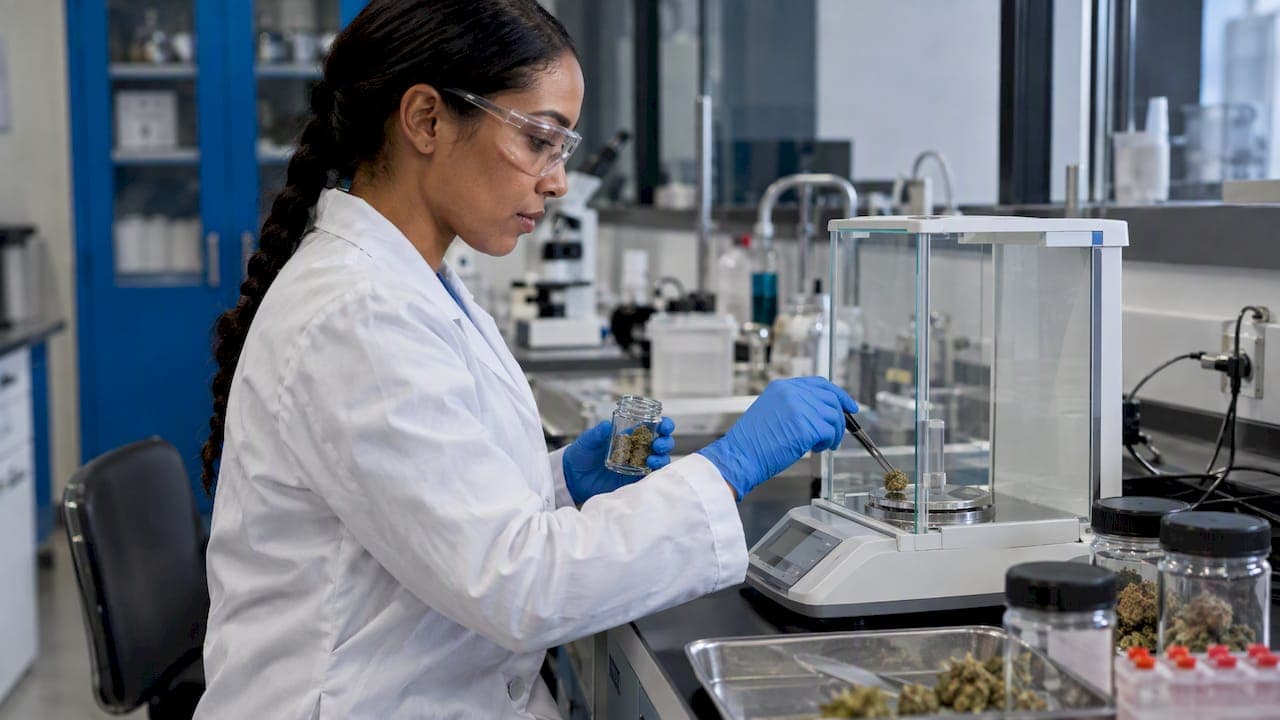
Lab-tested cannabis is flower or a product whose batch was sampled and analyzed by a third-party laboratory for potency, contaminants and, in many states, terpenes. The proof is a certificate of analysis (COA) tied to the batch number on your package. A COA is only worth what it shows: the right batch, a lab you can identify, and results for every panel your state requires.
TL;DR
- "Lab tested" means a representative sample of a batch was analyzed and the results were written up on a COA that states pass or fail for each tested substance.
- Required panels vary by state, but typically cover cannabinoids, microbials and other contaminants. Some states also require terpenes.
- Check that the batch number on the COA matches your package, that the lab is named, and that the results are complete.
- A COA describes one batch at one point in time. It does not prove how a product will feel or that it was stored well afterward.
- Some states license no testing labs at all, so a "tested" claim there rests on the seller's own diligence.
Table of Contents
- What "lab tested" actually means
- How a sample is collected
- What labs test for
- Microbial testing, in plain terms
- Testing standards: who sets the rules
- How to read a COA in five checks
- What lab results can and cannot prove
- Our perspective: testing is a starting point
- Where to see this in practice
- FAQ
- Sources
What "lab tested" actually means
The phrase gets used loosely, so it helps to separate three things.
Compliance testing is required by a state regulator before a regulated product can be sold. In California, the Department of Cannabis Control requires all batches of cannabis goods to be tested before sale, to check that they are free of contaminants and labeled with accurate amounts of cannabinoids and terpenes. New Jersey's Cannabis Regulatory Commission mandates testing by a licensed third-party laboratory before retail sale, to provide safety, quality and potency information.
Voluntary testing is what a grower or brand commissions when no regulator demands it, or on top of what the regulator demands. Hemp flower, for example, often sits in this category depending on the state and the product.
In-house testing is a quick check run by the producer. It is useful for decisions during cultivation, but it is not an independent result, and it should not be what a "lab tested" label rests on.

The independent, batch-specific COA is the standard worth looking for. Everything below explains how it is produced and how to read it.
How a sample is collected
A test result is only as good as the sample behind it. The Maryland Cannabis Administration says laboratories must use statistically valid sampling methods so the collected sample represents the entire batch. Its technical authority document also stresses that the goal of sampling is the integrity, representativeness and chain of custody of a batch, because poor sampling produces meaningless analytical data.
In practice, that means:
- The batch is defined. A batch is one lot of product that shares a harvest or production run, identified by a batch number.
- Subsamples are pulled from different places. Taking material from several spots in the lot avoids testing only the top of a container, where the best-looking buds may sit.
- Chain of custody is recorded. The sample is documented from collection through delivery, so the result can be tied back to the lot.
- The producer stays hands-off. New Jersey guidance says a cannabis business employee must be physically present to observe the collection but must not touch the product or equipment, which prevents contamination and interference.
This is why batch numbers matter so much. If a COA cannot be matched to a specific lot, the result cannot be tied to what is in your jar. For a closer look at how traceability works, see our piece on hemp batch numbers and traceability.
What labs test for
Panels differ by state, but most compliance programs draw from the same list.
| Test | What it looks for | Why it matters |
|---|---|---|
| Cannabinoids | THC, CBD and related compounds, reported as a percentage or mg/g | Confirms potency and label accuracy |
| Terpenes | Aromatic compounds that shape flavor and aroma | Documents the strain's profile, required in some states |
| Microbials | Bacteria, yeast, mold and specific pathogens | Flags contamination that could make people sick |
| Pesticides | Residues of agricultural chemicals | Shows what was left on the plant |
| Heavy metals | Trace metals such as lead and arsenic, picked up from soil or inputs | Safety screen for inhaled or ingested products |
| Mycotoxins | Toxins produced by certain molds | Catches a hazard that can remain after mold is gone |
| Residual solvents | Leftovers from extraction (concentrates) | Mainly relevant for extracted products, not flower |
The exact list and the limits depend on your state's rules. Some regulators publish their action limits openly, and that is the place to check what "pass" means where you live. Our guides on cannabinoids and terpenes and what their panels show and on pesticide and heavy-metal results go deeper on each panel.
Microbial testing, in plain terms
Microbial testing is the panel most people ask about, because failure here is a health issue rather than a quality one. It checks two kinds of things: specific dangerous organisms, and general counts of microbes.
Using New Jersey as a worked example, the state's testing guidance says microbial tests must show that Shiga toxin-producing E. coli, Salmonella and pathogenic Aspergillus are not detected in 1 gram. For total aerobic bacteria and total yeast and mold in usable cannabis for distribution, the same guidance sets a ceiling of 100,000 CFU/g. CFU stands for colony-forming units, a count of how many organisms grow from a gram of material.
Two ideas help you read these results:
- Presence/absence results are binary. "Not detected" is the pass. Anything else is a fail.
- Count results are numbers measured against a limit. A result under the limit passes, and one over it fails, even if it looks small.
Other states set different limits and different pathogen lists, so treat the New Jersey numbers as an example of how the rules are built, not a national standard. There is no single federal testing standard for state-regulated cannabis, which is why a label from one state does not tell you what was tested in another.
Testing standards: who sets the rules
The rules are written state by state, and the differences are real.
- States with licensed labs and mandatory testing (California, New Jersey, Washington and others) require batches to pass before retail sale. Washington's Liquor and Cannabis Board says retailers must sell products tested by a certified laboratory to limit public health risks.
- States with no licensed labs. Pages ranking for this topic note that Texas and North Carolina do not license independent cannabis testing labs for marijuana. There, a testing claim depends on whoever makes it.
- Method requirements. Regulators also govern how labs work. New Jersey requires labs to set the limit of quantification for each analyte at no more than half the action limit, except for presence/absence microbial tests, and to verify they can perform a method validated by a third-party body such as AOAC.
The limit of quantification point is more practical than it sounds. It means a lab's method must be sensitive enough to detect a contaminant well below the level that would fail the product. A lab that can only detect something at the limit itself cannot tell you much about a batch near it.
For the methods behind potency numbers, see cannabinoid testing methods explained.
How to read a COA in five checks
A certificate of analysis is the lab's report for one batch. California requires labs to report on a COA that indicates whether a batch passed or failed each tested substance. New York's Office of Cannabis Management describes a COA as a certified lab report of testing results that also shows the quality assurance measures a product was tested for.
Use this order:
- Match the batch. The batch or lot number on the COA should be identical to the one printed on your package. If it is missing or different, the document tells you nothing about what you hold.
- Identify the lab. A real report names the laboratory, and in regulated states it should be licensed there. A report with no lab name is a marketing graphic.
- Check the dates. Look at the sample, test and report dates. Cannabis changes over time, so a report from long before the harvest date is a red flag.
- Look for every panel. Cannabinoids alone are not a safety result. You also want microbials, pesticides, heavy metals and, where required, mycotoxins and terpenes.
- Read pass or fail, not just potency. A high THC number is not a quality signal. The pass or fail lines on contaminants are the safety signal.
In Washington, consumers have the right to request a COA from a retailer for any product they plan to buy. If a seller cannot or will not provide one, that tells you something.
We walk through these steps with examples in our guides to reading a hemp flower COA and reading a terpene test report.
What lab results can and cannot prove
A COA is strong evidence, but it has limits worth knowing.
What it can establish
- The measured cannabinoid content of the sampled batch, within the method's accuracy.
- Whether contaminants were above or below the action limits when tested.
- The terpene profile that was measured in that sample.
- That a licensed or accredited lab, if named, performed the analysis.
What it cannot establish
- How a product will feel. Potency and terpene numbers describe chemistry. Effects vary by person, dose and tolerance, and the research on how individual terpenes shape effects is far from settled.
- That the whole lot is uniform. Sampling methods are designed to be representative, but a result is still an estimate for the batch, not a test of every bud.
- What happened after testing. Heat, light, oxygen and time all degrade flower. A clean COA says nothing about a jar that sat in a hot warehouse.
- That nothing outside the panel is present. A lab tests for the listed analytes. Anything not on the panel is not covered.
- That the document is honest. In states with no licensed labs, or with a seller who will not name the lab, the COA's credibility depends on the issuer.
If you want a deeper look at how these results map onto a specific panel, the cannabinoids and terpenes panel guide shows what each line means.
Our perspective: testing is a starting point
We grow indoors in living soil, without plant growth regulators, and we control the process from seed to sale. That vantage point shapes how we think about testing.
The first lesson is that a lab report cannot fix a problem it did not catch. Clean results are the outcome of decisions made months earlier: what goes into the soil, how the plants are handled and how the room is kept. We would rather prevent a failed batch than rely on a test to sort the good from the bad.
The second is that a COA should be easy to find and easy to match. That is why we publish batch COAs and terpene profiles for our products, and why batch numbers are on the package. If you cannot trace a jar back to a report, the report has not done its job.

The third is that terpene data is part of the product story, not decoration. Keeping the authentic terpene profile of each strain is a growing goal for us, and a terpene panel is how you can verify the result instead of taking our word for it. We also package flower in engineered packaging meant to protect freshness, because a good batch can still be spoiled afterward.
Our advice to any buyer, from us or anyone else: ask for the COA, check the batch number, read the contaminant lines first and treat potency as the least important number on the page.
— Cali Farms
Where to see this in practice
If you would like to compare a COA against a real product, our Cali Farms Flower Collection lists each strain with its lab data and terpene profile. Strains such as Wedding Cake and Durban Poison are good starting points if you want to see how a report lines up with a product page. Retailers and distributors can also ask us about wholesale.

Before you order anywhere, confirm that cannabis or hemp flower is legal where you live and that the product is allowed to ship to your state, since rules differ.
FAQ
Is all cannabis lab tested?
No. In states with regulated markets, such as California, New Jersey and Washington, batches must be tested before retail sale. In states that do not license testing labs, there is no such requirement, so any testing is voluntary. Always look for the COA rather than relying on a label.
What is microbial testing for cannabis?
It checks for harmful organisms and for general microbial load. Typical panels look for pathogens such as E. coli and Salmonella and count total bacteria, yeast and mold. Each state sets its own pass and fail limits, so the numbers on your COA should be read against your state's rules.
How do I know a COA is real?
Check that the batch number matches your package, the lab is named, the dates make sense and every required panel appears. In regulated states you can confirm the lab's license with the state regulator. If a seller cannot name the lab or provide the full report, treat the claim with caution.
Does a high THC number mean better cannabis?
Not necessarily. THC percentage measures potency, not safety or quality. The contaminant results and the terpene profile tell you far more about how clean and flavorful a batch is. Effects also depend on your own tolerance and dose.
Can a lab-tested product still go bad?
Yes. A COA describes the batch at the time of testing. Heat, light, air and long storage can degrade flower afterward, which is why packaging and storage conditions matter as much as the report.
Sources
- Testing laboratories, California Department of Cannabis Control
- Cannabis Testing Guidelines and How to Read a Certificate, NJ Cannabis Regulatory Commission
- NJ-CRC Testing Guidance, February 2025
- Authority for Cannabis Testing, Maryland Cannabis Administration
- Understanding Test Results, Washington State Liquor and Cannabis Board
- How to Read a COA, New York Office of Cannabis Management